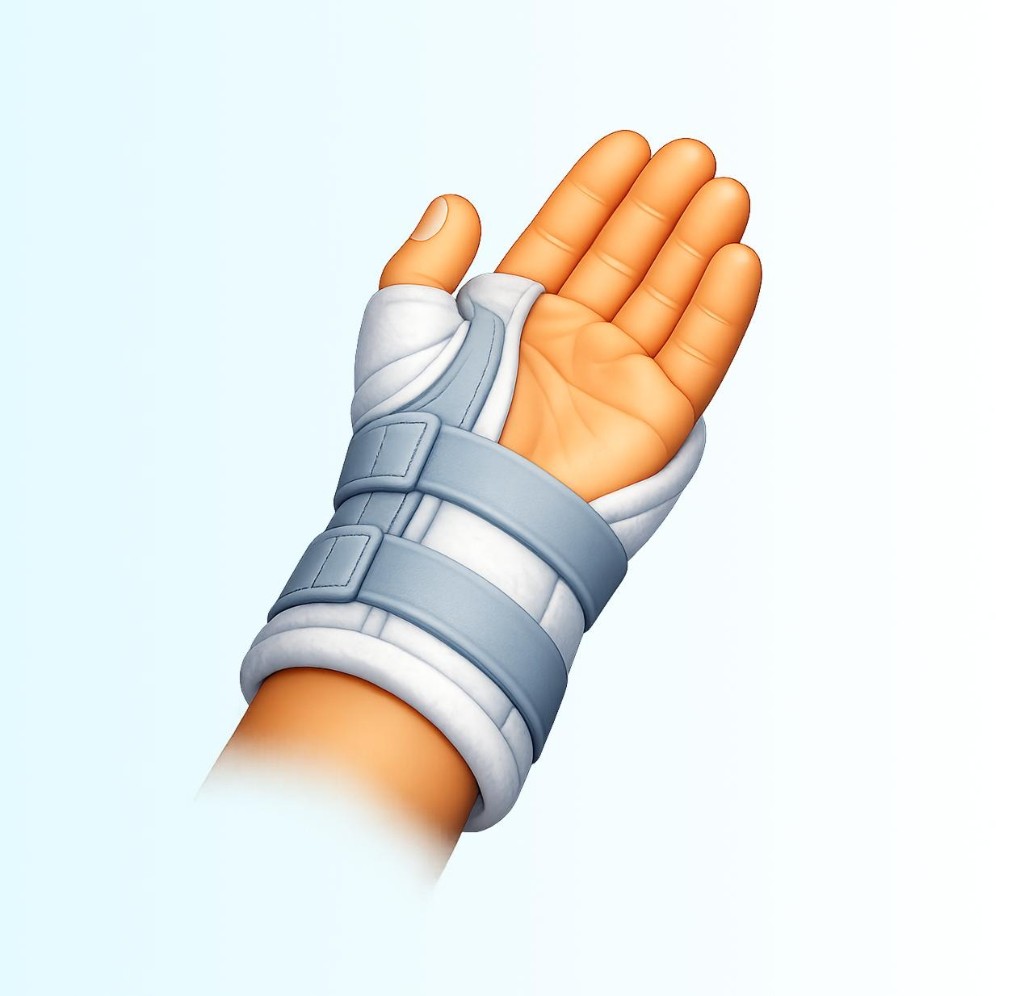
Goals, sensations, and stop rules on every card — tap to run a timed session with large controls.
Hand-heavy jobs & pacing
Education profiles for work-shaped loads — not job-site clearance.
Patient hub (hand-heavy)·Movements (desk / wrist)·Job profiles·Reels (my program)
37 / 37 exercises — filters apply instantly.
37 exercises match the current filters.
2 Sets • 5 Reps
Touch the thumb to each fingertip in turn, then open the hand wide to train precision and thumb opposition.
Prep: No special equipment
Form an 'O' by touching the thumb to the index finger on both hands to train pinch control and finger dexterity.
2 Sets • 8 Reps
Touch the tip of each finger with the thumb to rebuild fine motor control for buttons, keys, and writing.
Use your other hand to gently draw the thumb outward and hold, easing thumb tightness and web-space stiffness.
Hold the thumb steady and gently mobilize it with the other hand to ease basal-joint stiffness and improve glide.
Hold the thumb’s base joint still and bend only the tip — a focused glide for the flexor pollicis longus tendon used after thumb tendon repair or stiffness.
Use the other hand to move the thumb through its full range, easing tightness at the base and improving control.
Spread the fingers wide, then sweep the thumb across the palm to combine finger abduction with thumb mobility.
Interlock the fingers of both hands and gently stretch them together to mobilize the fingers and web spaces.
Press and release against a rubber resistance web (or substitute putty) using a large whole-hand grasp — a later-stage strengthening option when mobility is already acceptable.
Prep: Soft ball, sock, or therapy putty
Tuck the thumb into a loose fist, then extend it outward to train active thumb extension and base-joint control.
2 Sets • 12 Reps
Spread the fingers against a light looped band to wake up the small extensors that balance grip.
Prep: Rubber band / elastic loop
1 Set • 4 Reps
With the forearm supported and palm up, ease the wrist toward extension to stretch the front of the forearm — common after typing or gripping.
Hold the big knuckles bent and the smaller finger joints straight to lengthen the small intrinsic muscles of the hand — used after stiffness from immobilization or burns.
Point the index finger upward and use the other hand to gently stretch it back, easing finger-joint tightness.
Place the palm flat on a wall with fingers spread and lean in gently to stretch the wrist, palm, and forearm.
2 Sets • 10 Reps
Use a soft ball, sock, or therapy putty for gentle progressive grip work — only when symptoms are stable.
1 Set • 1 Rep
A very short same-origin clip used for automated reel / HTML5 checks. Patient education only — follow your clinician’s plan.
1 Set • 5 Reps
Encourage healthy median nerve mobility with a slow sequence of wrist and finger positions. Never push into symptoms.
2 Sets • 6 Reps
Stabilize the small finger joints while bending only the big knuckles — a classic hand-therapy drill to regain isolated MCP flexion and extension after stiffness or immobilization.
1 Set • 3 Reps
Use slow circles or gentle strokes along a healed scar to loosen tight tissue and improve glide — distinct from texture desensitization, but often used in the same recovery phase.
Slowly floss the ulnar nerve pathway with small wrist and finger changes. Stop if ring or small-finger numbness ramps up.
Slow wrist movements through bend, extend, and side-to-side to maintain comfortable joint mobility.
Make a loose fist and slowly rotate the forearm from palm-up to palm-down to mobilize the wrist and forearm.
Use the opposite hand to gently straighten the fingers and stretch the palm open when active extension is limited.
Make a tight but comfortable fist, hold briefly, then relax to build grip awareness and finger flexion.
Extend the arm, open the hand fully, and spread the fingers wide to counter clenching and finger stiffness.
Turn the palm down and up while the elbow stays steady — a staple motion for forks, doorknobs, and tools.
Prep: Stick, dowel, or pen (rotation aid)
Bend the fingers at the knuckles into a hook or claw shape, then straighten, to glide the finger tendons.
From an open palm, curl the fingers into a hook and back to open, gliding the finger tendons through their range.
Slowly close into a full fist, then open the hand wide — a gentle pumping motion for mobility and circulation.
With the palm on the table, slide each fingertip a short distance toward the thumb line and return — a gentle tendon excursion drill when composite glides are still uncomfortable.
Move the finger tendons through their full range with five gentle hand positions to reduce stiffness and adhesions.
With a closed fist, slowly bend the wrist down and back up to restore wrist flexion and extension range.
Briefly activate the small hand muscles, then exhale and ease the palm wider — a neuromuscular pacing drill sometimes used for tight hands when a therapist has taught you the pattern.
Elevate the hand above the heart and gently open and close the fingers to encourage fluid movement.
Progress through textures — from soft to firmer — to help the nervous system tolerate touch around healed scars.
Prep: Cloth or texture swatches
Voice commands
This browser does not support speech recognition for hands-free commands. Keyboard shortcuts still work on sessions and Reels.
Hand-friendly shortcuts
Splinted hand, limited reach, or no voice? Scroll the page with large buttons, double-tap Scroll down within a moment to change step size, and mute session sounds without digging into settings.
Step size: Medium steps — double-tap Down to cycle.